
The permission you don't need.
Most women lose a year chasing a license the law never asked them for.
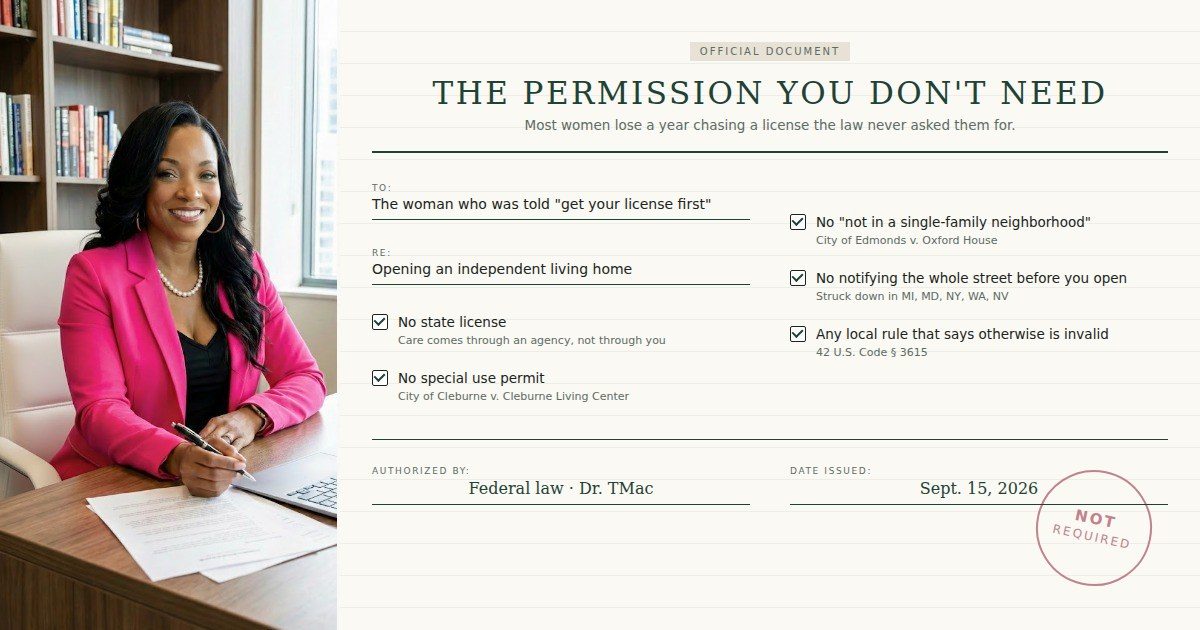
Here's the sentence I said over and over again, and the one I'll get the most arguments about: an independent living home does not require a state license.
Not a loophole. Not a gray area. It's how the law is written, and once you understand why, you'll never look at a house the same way.
A state licenses facilities that provide care. An assisted living facility helps with bathing, medications, dressing; the facility does the caring, so the state inspects the facility. An independent living home is a different thing. It's a home. Adults live there, share meals, share a household. If someone needs care, it comes from a third-party agency that the client chooses and the agency is responsible for. You provide the house and the household. You do not provide the care. And because you don't provide the care, there's nothing for the state to license.
That's the line, and it's a bright one. The moment you or your staff start doing the care yourselves, you've become a facility, and the license comes with it. Keep the care with the agency and you stay a home.
Now here's the part that almost nobody teaches, and it's the part I built my homes on.
Cities will try anyway. A neighbor complains. A zoning officer sends a letter. Somebody says you need a special use permit, or that "group homes aren't allowed in single-family neighborhoods," or that you have to notify the whole street before you open. Women get that letter and quit.
Every one of those requirements has been struck down in federal court. The Fair Housing Amendments Act, the Americans with Disabilities Act, and the Rehabilitation Act together say a city cannot treat a home for people with disabilities less favorably than any other home, cannot deny a permit because of who lives there, and cannot refuse a reasonable accommodation in its zoning rules. The Supreme Court threw out the special use permit in Cleburne. It threw out the single-family ban in Edmonds v. Oxford House. Michigan, Maryland, New York, Washington, Nevada, all had "notify the neighborhood" or registry rules, all struck down. And the statute goes further: any state or local law that would require a discriminatory housing practice is, in the law's own word, invalid. That's 42 U.S. Code 3615, and I keep a copy of it in the binder.
So when that letter comes, and one day it will, you don't panic and you don't close. You answer it with the law. Cities know they lose these cases, and they know what losing costs them: damages, penalties, attorneys' fees, and their HUD funding. Most back down the moment they realize you know it too.
That's what I mean when I say I teach ownership. Not "how to run a home." How to know exactly which permission you need, which permission you don't, and what to say when someone tries to charge you for the second kind.
The woman who knows this buys a house in a good neighborhood, sets the care up with an agency, opens without waiting on a licensing board, and is collecting from three clients while the woman next to her is still on month nine of an application she never needed.
Next week: six beds, and the four numbers that turn a house into a business that pays you.
We should all be rich friends. — Dr. TMac